
Growing on the Tatami
Learn.
Grow.
Try again.
Judo for children up to age 10.
It starts on the
movement.
Children run, roll, balance, fall and get back up. They learn about their bodies, respect rules and work with others.
Judo turns movement into an opportunity to learn.
Request a trial class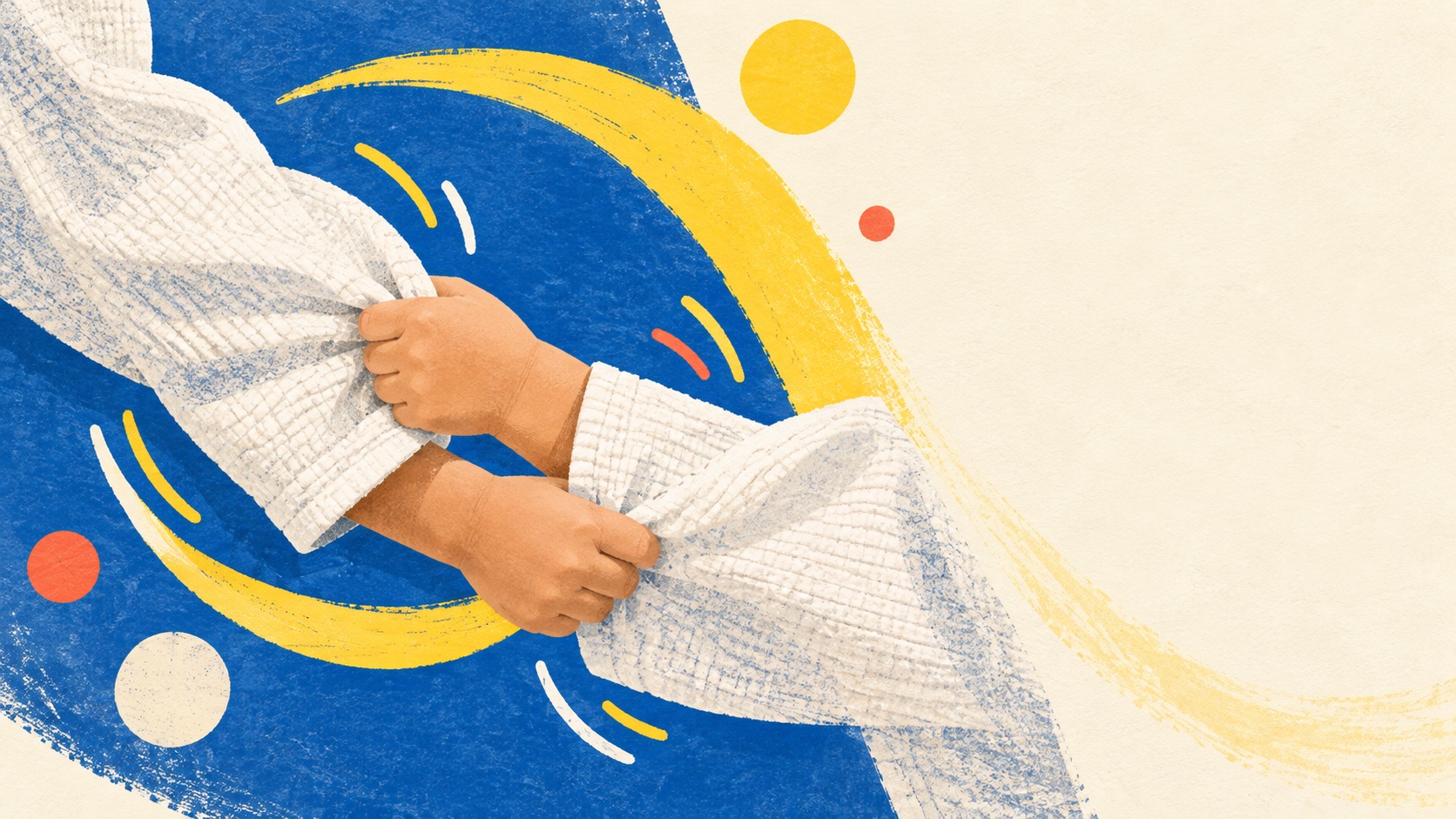
Learning in motion
Learning through movement.
In the early years, judo combines games, balance, safe falling and working with partners. It is guided practice, with clear rules and room to explore.For families
Questions
asked questions.
01Can my child start practising judo?
Yes.
No previous experience, particular fitness level or knowledge of judo is required.
Children begin with the basics through age-appropriate exercises: moving, balancing, rolling, falling safely, getting back up and working with partners.
The first aim is not difficult techniques or competition. It is discovering judo, building confidence and learning to use the body in a guided, safe environment.
02Is judo suitable for young children?
Yes, provided training is designed specifically for them.
Children up to age 10 follow Growing on the Tatami, with activities adapted to their age, attention span and motor development.
At this stage, judo is taught through movement, games, challenges and gradual exercises. Children learn while still playing, and also understand rules, times to listen and responsibilities towards their partners.
The aim is not to turn young children into adult athletes, but to give them a solid foundation for growing up.
03Is judo a violent sport?
No.
Judo is a contact sport, but learning is based on control, respect for partners and following rules.
Children learn that they cannot use strength however they like. They must control their movements, adapt to their partners and stop when an exercise ends.
A partner is not someone to hurt or humiliate. They are the person we need in order to learn.
This is one of judo's most important lessons: you can face opposition, compete and overcome difficulties while still respecting the other person.
04Will my child learn to fall?
Yes. Learning to fall is one of the first things taught in judo.
Teaching is gradual. Children begin close to the ground with simple, controlled movements, before progressing to more demanding situations.
Children learn to protect their bodies, control movement and react more safely when they lose their balance.
Learning to fall also has a wider meaning. Children understand that falling, failing or not succeeding at the first attempt does not mean giving up. They can get back up, understand what happened and try again.
05Does judo help develop coordination?
Judo offers children a wide range of movements and challenges.
Training develops balance, coordination, agility, spatial awareness, laterality and body control.
Children run, roll, change direction, move in different positions, react to their partners and learn to use their bodies with increasing awareness.
Children do more than repeat the same movement. They learn to adapt to different situations.
06My child is very shy. Can judo help?
Every child has their own pace.
In judo, confidence grows through small achievements: taking part, working with a new partner, learning a fall, completing a technique or overcoming a difficulty.
Children do not need to be the fastest, strongest or most outgoing to make progress.
Training offers opportunities to participate, try things and realise they can succeed. Over time, many children become more confident in how they move, communicate and face new situations.
The aim is not to change a child's personality, but to help them feel more confident as themselves.
07What if my child has a lot of energy?
Judo lets children move, while also teaching that there are times to stop, observe and listen.
To do an exercise, children need to understand the instructions, wait their turn, control their strength and pay attention to their partners.
Children learn that having energy does not mean acting without rules. They can run, play, challenge themselves and train hard within a structure that protects everyone.
Self-control is not something children are expected to bring from home. It develops gradually through practice.
08My child is not very sporty. Will they keep up?
You do not need to be especially fast, strong or coordinated to start.
Children arrive at judo with different experiences and abilities. Some adapt immediately to particular exercises; others need more time.
Training should allow every child to progress from their own starting point.
Rather than constantly comparing children, we follow what they are improving, the confidence they gain and how they respond to new challenges.
In judo, everyone has something to learn and everyone can develop.
09Does judo teach discipline?
Judo has clear rules, routines and responsibilities.
Children learn to enter the training space, bow, listen to instructions, care for equipment, respect their partners and stop an exercise when asked.
They also learn that techniques can only be practised safely and that strength must always be controlled.
Discipline in judo should not be based on fear or blind obedience. It comes from understanding that rules help us learn, protect our partners and belong to a group.
10Will my child learn to defend themselves?
Judo helps children understand their bodies, control their balance, fall more safely and handle physical contact in a guided setting.
It can also help them feel more confident in difficult situations.
But we do not teach children to seek confrontation or use techniques outside the appropriate context.
One of judo's main lessons is controlling strength, avoiding dangerous behaviour and understanding that knowing a technique also means knowing when not to use it.
11Tem de competir?
No.
Competition is an option in judo, but it is not compulsory and should not be every child's goal.
Some may want to compete later. Others will practise for the enjoyment of learning, social contact, exercise or the challenge of achieving a new grade.
Competition participation should depend on the child's age, preparation and wishes, with support from the coaches.
You can learn, develop and enjoy judo without competing.
12What if they want to compete?
When a child shows interest in competition, the club can support that journey.
Competition lets children apply what they have learned, face challenges and learn to win and lose. It should be a developmental experience, not a measure of a child's worth.
A result does not define a child or erase the work they have done in training.
As important as trying to win is respecting your opponent, accepting the result and returning to training wanting to improve.
13Is judo an individual sport?
The result of a contest is individual, but nobody learns judo alone.
Practising a technique requires a partner. Learning to fall requires help. Taking part in an exercise requires trusting that your partner will follow the rules.
Every child depends on the others to develop, while also contributing to their partners' learning.
Judo therefore develops not only individual skills, but also cooperation, responsibility and respect for the group.
14Will my child train with different children?
Yes.
In training, children meet partners with different abilities, personalities and learning speeds.
They learn to work with people who are shy or confident, experienced or new, bigger or smaller.
Partners are not all the same, and exercises vary in difficulty. Children learn to adapt their behaviour, control their strength and understand what their partners need.
Learning to get along is an essential part of the process.
15What do the belts mean?
Belts represent stages of learning.
A new grade recognises knowledge, development and work, but does not mean there is nothing left to learn.
A belt should not be seen only as a reward or a race to the next grade.
Each stage takes its own time. More important than changing belts is understanding judo better, becoming more independent and continuing to develop.
16What if my child does not succeed the first time?
That is part of the process.
Learning judo often requires repetition. A technique may seem difficult one day and become clearer after several attempts.
Children learn to deal with frustration, accept corrections and understand that making a mistake does not mean they are incapable.
We do not expect everything to be done correctly the first time. We expect children to be willing to try, listen, correct and try again.
17How can I support my child's progress?
Support from parents and guardians matters, but it does not need to become pressure.
Asking whether a child enjoyed training, what they learned or who they worked with may be more useful than only asking whether they won or are about to change belts.
It is important to value consistency, effort, the courage to try and how children treat their partners.
The club follows every athlete's development and can answer questions about adapting to training, progression and suitable goals.
18What can my child find in judo?
They can find a way to move and understand their own bodies better.
They can learn to fall, get back up and face difficulties.
They can build confidence, improve attention and gain greater control over their actions.
They can learn to respect rules, work with other children and take responsibility within a group.
They can compete or simply practise for the enjoyment of learning.
And they can find a place where they are known, supported and encouraged to grow.
19What if my child is unsure?
You do not need to decide in advance whether judo will be your child's lifelong sport.
They can start by trying a class, getting to know the space, taking part and seeing how they feel.
Some children arrive full of confidence. Others need to observe, get used to the environment and meet their partners.
Allowing that time is also part of the journey.
The first goal is not to know judo.
It is wanting to return to the tatami.